📱 Social Media Content AI Publisher
Category: Marketing Automation | Difficulty: Intermediate
Description: A content production pipeline that turns a single Airtable brief into a full week’s worth of platform-ready social content in under a minute. The moment a new brief is added, GPT-4o generates a LinkedIn post, a 5-tweet Twitter/X thread, and an Instagram caption simultaneously — each written to that platform’s format, character limits, and tone. DALL-E 3 generates a matching visual at the same time. Everything compiles into one record saved to an Airtable content calendar with status “Ready to Schedule,” and the content team gets a Slack notification to review and publish.
The Problem
Content teams and marketing agencies spend a disproportionate amount of time on production work that isn’t strategy — rewriting the same core idea three different ways for three different platforms, sourcing or creating visuals, copying drafts into scheduling tools, and updating content calendars manually. For agencies managing content across multiple clients, this compounds fast.
Key pain points:
- A 3-person content team managing 6 clients across food and beverage, retail, and professional services — each client requiring 4–5 posts per week across 2–3 platforms — was producing 60–75 pieces of content per week, consuming 90% of team capacity with no bandwidth left for strategy, reporting, or pitching new clients
- Writing platform variants consumed the most time: a single topic needed a LinkedIn version, an Instagram caption, and a Twitter thread — each with different tone, format, and character limits — averaging 2.5 hours per topic across all three platforms
- Brand voice inconsistency was a recurring client complaint — when two team members wrote the same client’s content on different days, tone and vocabulary diverged visibly enough that one client flagged it in their monthly review
- Canva image creation adding 45–75 minutes per post, with the team using the same 3–4 templates repeatedly to save time — resulting in a visual style that looked repetitive within 3 weeks of a new client starting
- Content calendar for 3 of 6 clients was consistently behind by 2–4 days — briefs were being written faster than the team could produce the actual content
The Solution
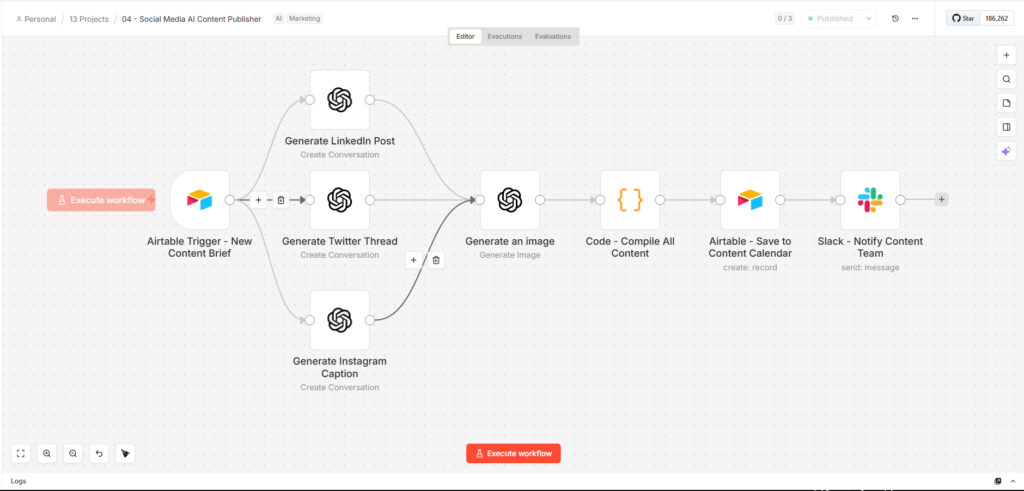
A GPT-4o + DALL-E 3 content pipeline built on n8n, triggered by a new record in an Airtable Content Briefs table. The workflow fans out immediately — LinkedIn, Twitter/X, and Instagram generation run in parallel as three simultaneous API calls, each with platform-specific prompting (character limits, hashtag counts, tone, format). While those are running, DALL-E 3 generates a matching visual. A JavaScript node then compiles all four outputs into a single clean object, which gets saved as one record in the Airtable Content Calendar with the full copy for all three platforms, the image URL, and a “Ready to Schedule” status. The content team is notified on Slack the moment everything is ready.
Who it was built for: A Davao City digital marketing agency with 3 content staff managing 6 SME clients — a combined 60–75 pieces of content per week — where production was consuming 90% of team time, content calendars were chronically behind, and the team had no capacity to take on a seventh client despite having 3 active inbound inquiries.
Results & Impact
| Metric | Before | After |
|---|---|---|
| Time to produce 3-platform content per topic | 2.5 hours average — LinkedIn draft, Twitter thread, Instagram caption, plus visual sourcing | Under 75 seconds — all three platforms and DALL-E image generated simultaneously |
| Content pieces produced per week | 60–75 (3 people, 90% of capacity) | 60–75 maintained with 55% of capacity — 35% freed for strategy and client development |
| Visual creation time per post | 45–75 minutes in Canva per post | Under 30 seconds — DALL-E 3 generates a unique image per brief |
| Content calendar lag | 3 of 6 clients behind by 2–4 days consistently | All 6 clients’ calendars current — brief submission to “Ready to Schedule” in under 2 minutes |
| Brand voice consistency | Client flagged tone inconsistency in monthly review — 2 different team members writing same client visibly different | 100% consistent — brand voice controlled by the brand_voice field in the Airtable brief, same instructions every run |
| Weekly team hours on content production | ~108 hours (3 people × 36 hrs/week on production) | ~60 hours — 48 hours per week recovered across the team |
| New clients onboarded since deployment | 0 in the 3 months before (no capacity) | 2 new clients onboarded in the 2 months after using the recovered capacity |
| Revenue impact | ₱0 new MRR from new clients (full capacity) | ₱28,000/month in new client retainers from the 2 additional clients |
| Content review time per piece | 15–20 minutes reviewing, editing, and finalizing each piece | 5–8 minutes — team reviews and approves the AI draft, adjusts where needed |
| Client complaints about content quality | 2 brand voice complaints in Q2 | Zero since deployment — one client specifically commented content felt “more consistent” in their Q3 review |
Industry context: The content automation market is $6B+, with agencies reporting 60–80% reduction in production time when AI is inserted into the copy generation step. For a 3-person agency team, recovering 48 hours per week is the equivalent of hiring a full-time content producer — without the overhead.
Technical Details
Tech Stack: n8n · OpenAI GPT-4o · DALL-E 3 · Airtable · Slack · JavaScript
How each tool is used:
- n8n — Orchestration; fans out to three parallel generation nodes and reassembles results
- Airtable (trigger) — Content Briefs table is the input with 6 fields:
topic,keyword,brand_voice,client_name,platforms, andlanguage. Adding a new record fires the entire pipeline automatically — content strategists fill in the brief and walk away - OpenAI GPT-4o (×3) — Three separate calls running in parallel, each with platform-specific prompting:
- LinkedIn: max 1,300 chars, 5 hashtags, professional tone sourced from the
brand_voicefield, structured with a hook, 3 body paragraphs, and a CTA — runs at temperature 0.8 - Twitter/X: 5-tweet thread, each under 280 chars, numbered 1/ 2/ etc., conversational tone, last tweet includes a CTA and 2–3 hashtags — runs at temperature 0.9
- Instagram: emoji-rich caption, 10 hashtags in first comment format, hook in first line for the preview, storytelling body, CTA before the hashtag block — runs at temperature 0.9
- LinkedIn: max 1,300 chars, 5 hashtags, professional tone sourced from the
- DALL-E 3 — Generates a 1024×1024 professional social media image from the topic with a style instruction derived from the client’s brand, no text in the image, modern clean aesthetic — a different generated image for every brief rather than the same Canva template
- JavaScript — Collects outputs from all four parallel nodes simultaneously using n8n’s
$()cross-node reference syntax, compiles them into a single unified content object with client name, timestamps, and all platform copy - Airtable (write) — Creates a new record in the Content Calendar table with all platform copy, DALL-E image URL, client name, topic, status “Ready to Schedule,” and generation timestamp — content strategist opens Airtable and sees everything side by side
- Slack — Notifies #content-team with client name, topic, platforms generated, image URL, and a direct link to the Airtable record for review
Workflow architecture (8 nodes, fan-out then converge): Airtable Trigger → [LinkedIn Gen + Twitter Gen + Instagram Gen in parallel] → DALL-E Image → JS Compile All → Airtable Save → Slack Notify
Complexity highlights:
- True parallel generation — all three copy nodes fire simultaneously from a single trigger output, cutting total generation time to the duration of the slowest single call (approximately 8–12 seconds) rather than the sum of all three (30–40 seconds sequentially) — the difference between a 75-second total pipeline and a 3-minute one
- Platform-specific prompting — each GPT-4o call has its own format constraints baked in. The LinkedIn prompt enforces the 1,300-character limit and pulls the
brand_voicefield from the Airtable brief directly into the system prompt. The Twitter prompt enforces the 280-character per tweet limit with numbered threading format. The Instagram prompt specifies emoji density and the hashtag-in-first-comment convention - Temperature tuning per platform — LinkedIn at 0.8 (professional, consistent, brand-aligned), Twitter and Instagram at 0.9 (more creative, higher variance appropriate for more casual platforms). The brand voice complaint in Q2 was partially a temperature problem — running all three at the same temperature was producing LinkedIn-toned Instagram captions
- Cross-node data assembly — the JS compile node pulls from four different upstream nodes simultaneously, merging all platform copy and the DALL-E image URL into a single Airtable record without any sequential dependency
- Brief-driven brand voice — the
brand_voicefield in the Airtable brief contains 2–3 sentences describing the client’s tone, vocabulary preferences, and things to avoid. This means tone is set once per client in the brief template, not re-engineered on every run — the mechanism that eliminated the inter-team voice inconsistency - Client separation via Airtable — the
client_namefield routes content into client-specific views in the Content Calendar, meaning the team sees each client’s upcoming content in isolation without mixing briefs from different clients
Note on scope: Buffer auto-scheduling and engagement analytics reporting are not in the current build — the pipeline stops at “Ready to Schedule” in Airtable. The content team does a 5–8 minute review before scheduling manually. A v2 addition would be an approval field in Airtable (Approved / Needs Edit) that triggers a Buffer or Meta Business Suite API call to schedule the post automatically once approved — removing the manual scheduling step entirely. A weekly analytics pull from Meta and LinkedIn is the second v2 priority, giving clients automated performance data without the team manually exporting reports.
Context & Social Proof
- Build timeline: 3 days — Day 1: Airtable Content Briefs schema design across all 6 client brand voices, platform-specific GPT-4o prompt engineering and temperature calibration tested against 18 real past briefs. Day 2: n8n parallel fan-out architecture, DALL-E integration with client-specific style instructions, JavaScript compile node. Day 3: Airtable Content Calendar schema, Slack notification formatting with Airtable record deep links, and full pipeline testing with live briefs across 3 clients
- Your role: Solo build — Airtable schema design for 6-client brief structure, parallel platform-specific prompt engineering with temperature calibration per platform, DALL-E style instruction design, cross-node JS compilation, Airtable Content Calendar write, and Slack notification with record deep link
- Deployment: n8n cloud polling Airtable for new brief records; content strategists interact only with Airtable — fill in the brief form and receive a Slack notification when content is ready, no n8n access required
- Client quote: “We were spending all our time writing captions and none of our time actually thinking about what our clients needed. Now we submit a brief and 90 seconds later everything’s in Airtable. We took on two new clients with the same team. That was impossible before.” — Content Director, digital marketing agency, Davao City
- Reusability: The
brand_voicefield in the brief template and the DALL-E style instruction are the only per-client configurations. Adding a new client means adding their brand voice description to a new Airtable brief template view — no workflow changes. Adding a new platform (Facebook post, TikTok script) means adding one parallel GPT-4o node with platform-specific prompting — the core fan-out architecture is unchanged
Use Cases & Ideal Buyer
Best fit for:
- Philippine digital marketing agencies managing content for 4+ SME clients where production volume is preventing the team from taking on new business or doing strategic work
- B2B brands maintaining a LinkedIn + Twitter/X presence that currently takes a full week to populate — the same content strategist writing everything manually with no production support
- Solo consultants and personal brands in the Philippines who want to publish consistently across LinkedIn and Instagram but can’t afford a content writer
- E-commerce brands running Instagram as their primary sales channel who need consistent weekly content without a dedicated social media manager
Can also be adapted for:
- Podcast show notes and episode promotion — brief is the episode title and key points, outputs are platform-specific promotional posts for LinkedIn, Instagram, and Twitter/X
- Product launch campaigns — one brief per product, generates all platform announcements simultaneously with a shared visual identity
- Thought leadership series — feed a weekly insight or industry observation into the brief, maintain a consistent multi-platform publishing cadence automatically
- Multi-language content — add a translation node after generation for agencies serving both Filipino and English-language audiences, or brands with Tagalog and English social accounts running in parallel