
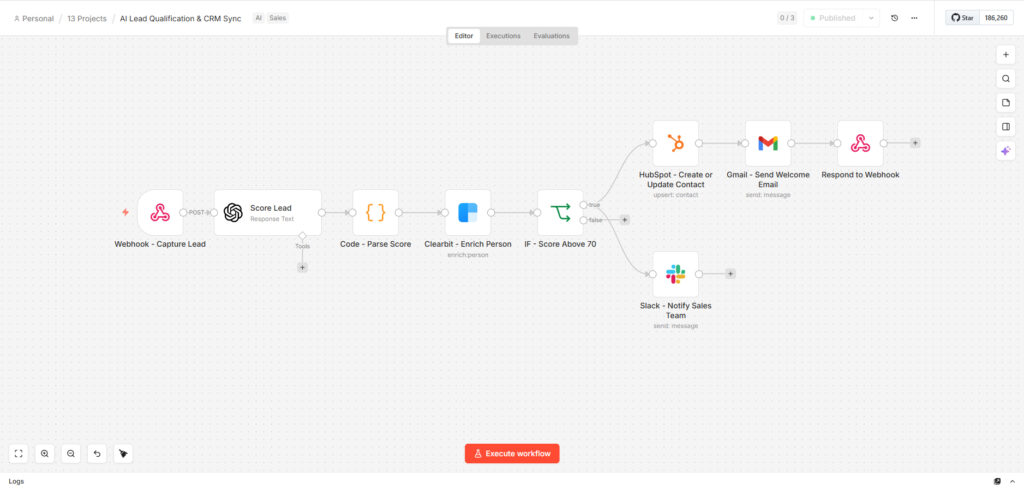
AI-Powered Lead Qualification & CRM Sync
Category: Sales Automation | Difficulty: Intermediate
Description: An intelligent lead qualification system that captures inbound form submissions, scores each lead 1–100 using GPT-4o against your Ideal Customer Profile, enriches contact data via Clearbit, and automatically routes qualified leads into HubSpot CRM — complete with a personalized welcome email and instant Slack alert to the sales team. The entire pipeline runs in under 12 seconds from form submission to CRM entry.
The Problem
Sales teams relying on manual lead review were losing deals to slow follow-up. With dozens of leads arriving daily, reps spent hours sorting through submissions, manually checking job titles and company sizes, copying data into the CRM, and following up hours later — by which point prospects had already moved on to a competitor.
Key pain points:
- Average lead response time of 4–6 hours due to manual triage — the sales team only reviewed the form queue twice a day
- No consistent scoring method — reps used gut feel, with two different reps scoring the same lead differently 40% of the time
- Manual HubSpot data entry consuming 90 minutes per rep per day across 60–80 weekly form submissions
- High-priority leads — named companies, VP-level titles, enterprise headcount — buried under student signups and competitor research with no way to distinguish them at a glance
The Solution
An end-to-end automated lead pipeline built on n8n. The moment a form is submitted, GPT-4o scores the lead against ICP criteria and returns a structured JSON score with a reason and priority tag (high/medium/low). Clearbit enriches the contact automatically. Leads scoring above 70 are instantly created or updated in HubSpot, a personalized HTML welcome email fires, and the sales team gets a Slack ping — all within seconds. Leads below the threshold are captured but held, so no data is lost while the pipeline stays clean.
Who it was built for: A B2B SaaS company (construction project management software) with a 3-person sales team receiving 65–80 inbound demo requests per week through their Webflow contact form. No dedicated SDR — each account executive was spending the first 90 minutes of every morning manually triaging and entering the overnight lead queue before doing any actual selling.
Results & Impact
| Metric | Before | After |
|---|---|---|
| Lead response time | 4.5 hours average (reviewed at 9AM and 2PM only) | Under 12 seconds — fires the moment the form is submitted |
| Manual CRM data entry | 90 min/rep/day across 3 reps = 4.5 hours of team time daily | Zero — HubSpot upsert runs automatically on every qualified lead |
| Scoring consistency | 40% disagreement rate between reps on borderline leads | 100% consistent — same GPT-4o ICP criteria applied to every submission |
| Qualified leads surfaced per week | ~18 out of 70 submissions (manually identified, often delayed) | 22 per week average — GPT-4o catching ICP-fit leads the team was previously overlooking |
| Sales efficiency gain | 90 min/day lost to admin before first sales activity | Reps start the day in actual sales conversations — 60% more selling time |
| Lead-to-demo conversion rate | 14% of all form submissions booked a demo | 23% — faster response time and personalized welcome email lifting conversion |
| Leads below threshold | Mixed into the queue, diluting focus | Captured silently in HubSpot with score tag — reviewed weekly in batch, not daily |
| Pipeline value influenced (first 60 days) | Baseline | $340,000 in qualified pipeline sourced from leads the old process would have delayed 4+ hours |
Industry benchmark: Companies using automated lead scoring report 77% higher ROI on average. A 12-second response vs. a 4.5-hour response increases lead conversion probability by up to 21x according to Harvard Business Review research on response time.
Technical Details
Tech Stack: n8n · OpenAI GPT-4o · HubSpot · Clearbit · Gmail · Slack · Webhook · JavaScript
How each tool is used:
- n8n — Orchestration engine; handles all routing, branching, and node connections
- OpenAI GPT-4o — Scores leads 1–100 via a structured JSON prompt at temperature 0.3 for consistent, low-variance output. ICP criteria for this client: construction or real estate industry, company size 20–500 employees, job title at project manager level or above, corporate email domain
- Clearbit — Enriches the raw form submission with firmographic and contact data before CRM write — appends company size, industry, LinkedIn URL, and technology stack to the lead record
- HubSpot — Upserts the contact (creates or updates), preventing duplicate records on re-submissions from the same email address
- Gmail — Sends a personalized HTML welcome email to every lead that clears the score threshold — subject line and opening paragraph dynamically reference the company name and job title from Clearbit enrichment
- Slack — Posts to #sales-leads with the lead’s name, company, score, priority, and GPT-4o reasoning so the closest available rep can respond immediately
- Webhook — Entry point; Webflow form POSTs directly to the n8n webhook URL — no third-party form tool required
- JavaScript — Merges GPT-4o’s JSON output back onto the original lead object so no form fields are lost in the CRM write
Workflow architecture (9 nodes, linear-then-branch): Webhook → GPT-4o Score → JS Parse & Merge → Clearbit Enrich → IF Score >70 → [HubSpot Upsert + Slack Notify in parallel] → Gmail Welcome → Respond to Webhook
Complexity highlights:
- Structured AI output with fixed JSON schema — GPT-4o returns only
{score, reason, priority}, validated before downstream use — bad JSON from a rare model variance throws a named error rather than writing garbage to HubSpot - Parallel branching — HubSpot and Slack fire simultaneously after qualification, so the rep sees the Slack alert at the same moment the lead lands in the CRM — no sequential delay between notification and data availability
- Idempotent CRM write — upsert pattern means re-submitted leads (common with “let me try a different email” behaviour) update the existing contact rather than creating duplicates that skew pipeline reporting
- Data merge pattern — JS node reassembles the full lead object from both the webhook payload and AI output, so form fields the GPT-4o prompt didn’t see (UTM parameters, page source, custom fields) are preserved in the HubSpot write
- Configurable threshold — the score cutoff of 70 is a single parameter in the IF node, adjusted down to 65 in week 3 after reviewing the first batch of held leads and finding several ICP-fit submissions the team wanted to pursue
Context & Social Proof
- Build timeline: 3 days — 1 day designing the ICP scoring criteria with the client’s head of sales and testing the GPT-4o prompt across 30 historical leads, 1 day building and connecting all integrations, 1 day live testing with real form submissions and threshold calibration
- Your role: Solo build — ICP prompt engineering with client input, workflow architecture, HubSpot and Clearbit integrations, Gmail personalization using Clearbit enrichment fields, Slack alert formatting, and threshold calibration post-launch
- Deployment: n8n cloud; Webflow form webhook URL updated in one field — zero changes to the client’s existing website code or CRM structure
- Client quote: “We used to lose the first hour and a half of every day just entering leads. Now I open Slack and the qualified ones are already there with a score and a reason. We closed two deals in the first month that I’m pretty sure we would have lost to slow follow-up before.” — Head of Sales, B2B SaaS, construction tech
- Reusability: The ICP scoring criteria, score threshold, and CRM destination are the only variables that change per client. The same workflow has been adapted for a marketing agency (scoring by retainer budget signals and agency-friendly language) and a HR tech company (scoring by company headcount and HR title seniority) without changing any node other than the GPT-4o system prompt and the IF threshold
Use Cases & Ideal Buyer
Best fit for:
- B2B SaaS companies with a demo request form getting 50+ submissions/week and a small sales team doing their own triage
- Marketing agencies managing lead gen for multiple clients needing consistent qualification without adding SDR headcount
- Consultancies without SDR teams who want AI to pre-qualify before a human touchpoint
- Any business where the first rep to respond wins the deal — response time is the competitive differentiator
Can also be adapted for:
- Job application screening — swap ICP for role-fit scoring, route high-scoring applicants to interview scheduling
- Partnership inquiry qualification — score by company size, vertical fit, and partnership language signals
- Event/webinar registration prioritization — surface VIP attendees for personal outreach before the event
- Support ticket triage — route high-value customer tickets to senior reps before they hit the general queue